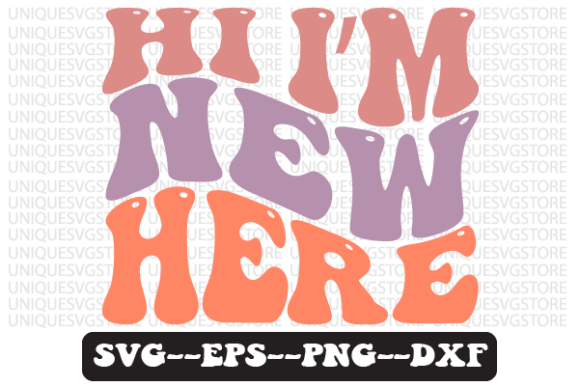
Hi I’m New Here Wavy Retro SVG Design
A Designer’s First Look: Friendly, Nostalgic, and Just Right for Handmade Charm
When I opened Hi I’m New Here Wavy Retro Svg Design, my first thought wasn’t “cute” or “trendy”—it was “this feels like a warm handshake.” The wavy baseline, soft retro curves, and clean but relaxed letterforms immediately signal approachability. It’s not loud or ironic—it’s genuinely welcoming, with just enough personality to stand out on a handmade product without shouting. As someone who evaluates hundreds of embroidery files each year for client projects and craft business use, I appreciate how this design avoids overcomplication: no tiny serifs, no overlapping elements, no fragile negative space. That simplicity isn’t lazy—it’s intentional craftsmanship.
Where It Shines: Real Projects That Feel Thoughtful, Not Trend-Chased
Last week, I used Hi I’m New Here Wavy Retro Svg Design to embroider a set of linen tote bags for a local boutique’s “First Day Back” launch—think teachers, new hires, and fresh-start energy. On the natural weave of medium-weight linen, the wavy line translated beautifully in satin stitch, holding its shape without stiffness. The curve gave subtle movement across the fabric, making each bag feel hand-placed rather than machine-perfect—and that’s exactly what customers love in handmade products.
It also worked well on cotton sweatshirts for a small Etsy shop targeting new parents. Paired with a simple embroidered star or heart (as an optional accent), it became part of a cohesive nursery-themed collection—not just text, but tone. For baby embroidery, the rounded edges soften the message, avoiding any unintended sharpness. And yes, it reads clearly at 3.5 inches wide—the sweet spot for onesies and toddler caps.
I’ve seen this design succeed as a custom embroidered patch too. When digitized with balanced stitch density and moderate underlay, the wavy flow stays legible even after repeated washing. That’s critical for commercial embroidery where durability equals trust.
Where to Pause: Texture, Scale, and Fabric Realities
This isn’t a one-size-fits-all embroidery file. Its gentle wave becomes less distinct on highly textured fabrics like terry cloth or bouclé—so skip it for kitchen towels unless you’re willing to add extra stabilizer and reduce stitch density. On thin or stretchy fabrics (think lightweight rayon tees or baby knits), test first: the curve can distort if tension isn’t dialed in or if stabilizer choice is off.
Dark fabric? No problem—but avoid light thread on black fleece unless you’re using high-contrast poly or metallic. And while it’s lovely on mugs and wall art as a printable PNG or sublimation design, remember: those are flat applications. Embroidery adds dimension, so what looks airy on screen may read heavier in thread. Always check a black-and-white mockup before finalizing your color palette.
Don’t force it into tiny hoop sizes. Below 2.75 inches wide, the lowercase “i” and the subtle wave lose definition. Save the compact version for iron-on patches—not delicate cap fronts or curved visors where distortion risks blurring the friendly vibe.
What It Adds to Your Craft Business—Beyond the Stitch
Hi I’m New Here Wavy Retro Svg Design quietly elevates perceived value. It doesn’t scream “limited edition,” but it *feels* considered—like the kind of detail that makes a customer pause mid-scroll on Etsy. That matters for small shop products where differentiation is subtle but powerful. Buyers don’t just buy text; they buy mood, memory, and intention. This design delivers all three without needing explanation.
For digital product sellers, it’s versatile as a design asset: layer it with vintage icons, pair it with minimalist florals, or reverse it for a clean wall-art print. As a graphics file, it scales cleanly—no pixelation in printable mockups or social media previews. But as a machine embroidery design, its strength lies in readability and rhythm. That rhythm builds brand consistency across tote bags, aprons, and pillow covers—even when colors and fabrics shift.
And let’s be real: it’s gift-ready. A personalized gift with this stitched on a canvas apron or tea towel lands differently than generic script. It says “I chose this for you”—not “I grabbed the first thing that fit.” That emotional resonance translates directly to reviews, repeat orders, and word-of-mouth referrals.
Practical Notes Every Embroidery Designer Should Run Through
- Test first: Stitch on scrap fabric matching your final project’s weight and stretch.
- Stabilizer matters: Use cutaway for knits, tear-away for stable wovens, and consider topping for napped fabrics.
- Thread contrast is non-negotiable: Preview your chosen thread colors against both light and dark backgrounds before stitching.
- Check stitch density: Overly dense fills will flatten the wave; lighter fill or satin-stitched outlines preserve motion.
- Hoop size & placement: Measure the full width—including curve amplitude—to avoid trimming or awkward centering.
- Licensing clarity: Since this is listed as a Graphics file usable for crafts and sublimation, confirm whether commercial embroidery rights are included before selling finished embroidered items or bundling it into digital embroidery kits.
- Compare mockups: View it in grayscale and at 75% scale—this reveals hidden legibility issues before you commit thread and time.
Final Thought: A Design That Works With You, Not Around You
Hi I’m New Here Wavy Retro Svg Design won’t replace your go-to monogram or complex applique design—but it fills a quiet, essential niche: the human moment in handmade work. It’s the kind of embroidery file you reach for when you want warmth over wow, clarity over clutter, and sincerity over saturation. Whether you’re building a craft business, prepping for a holiday market, or stitching a meaningful gift, this design supports your voice instead of competing with it. That’s rare. And that’s why it earns space—not just in your design library, but in your most thoughtful projects.