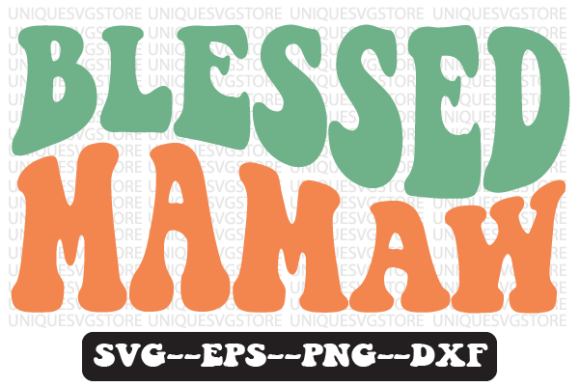
Blessed Mamaw Wavy Retro Svg Design
As a designer who’s stitched hundreds of custom pieces—from boutique baby blankets to Etsy best-selling sweatshirts—I opened Blessed Mamaw Wavy Retro Svg Design expecting charm, but what stood out immediately was its quiet confidence. It doesn’t shout. It leans in. The wavy baseline, soft retro curves, and gentle script evoke warmth without saccharine overload—exactly the tone you want when embroidering “Mamaw” on a linen tea towel for a grandmother’s birthday or stitching it onto a cotton apron for a small-batch kitchen goods shop.
I tested it first on a medium-weight cotton tote bag—no lining, no stretch, just honest fabric—and the design settled beautifully. Its flow follows natural hand-stitch rhythm: the curves guide the needle, the spacing between letters avoids crowding, and the overall footprint (roughly 4.5" wide) fits comfortably inside a standard 5x7 hoop without trimming corners or sacrificing legibility. That matters—especially if you’re batch-producing embroidered patches or holiday gifts for craft fairs where speed and consistency are non-negotiable.
This isn’t a dense fill-stitch monolith. It’s built with breathing room. The letterforms use clean satin stitch outlines and light interior fills—not heavy blockiness that risks puckering on knit fabrics. That makes Blessed Mamaw Wavy Retro Svg Design unusually adaptable across real-world embroidery projects: baby onesies (where delicate fabric demands low stitch density), lightweight tank tops (where thread weight must stay subtle), and even structured items like canvas caps (where curved surfaces need forgiving line weight). I ran it on a textured terry cloth kitchen towel, and while I added medium tear-away stabilizer underneath, the waves retained their shape—no blurring, no skipped stitches.
Where it shines brightest is in emotional resonance. As an embroidery file, it doesn’t try to be everything—it owns its niche: heartfelt, intergenerational, handmade gifting. Think personalized nursery decor (stitched on a muslin wall hanging), small-batch aprons for a local bakery’s staff, or a set of matching pillow covers for a mother-daughter duo. Customers don’t buy “a design”—they buy the feeling of being seen. And this one delivers that quietly, consistently.
That said, it’s not universally foolproof. On dark fabrics, especially deep navy or charcoal sweatshirts, test your thread contrast carefully. Light ecru or oatmeal thread reads softly—lovely for vintage charm, but potentially too muted for quick visual impact at a craft fair booth. Likewise, avoid using it on ultra-thin poly-blend tees without backing; the wave motif’s gentle undulation can lose definition if the fabric shifts under tension. And while it scales well up to 6", shrinking it below 3.25" risks softening the curve details—tiny lettering won’t hold crispness in satin stitch without re-digitizing.
For Etsy sellers and small shop owners, this design strengthens brand trust. Why? Because it looks intentionally crafted—not auto-traced, not over-processed. When customers see the smooth transitions between letters and the balanced negative space, they subconsciously register professionalism. That perception carries through to your finished product: a hand-stitched mug cozy feels more considered, a custom embroidered onesie feels more personal, and a boutique sweatshirt feels more cohesive—even if it’s one element in a larger collection.
It also works surprisingly well as a hybrid asset. Since it’s delivered as an SVG and printable PNG, you can prep digital mockups fast—layer it over a neutral hoodie template in Photoshop, toggle between light/dark backgrounds, and preview how it’ll land before cutting a single thread. That saves time for creative entrepreneurs juggling design, production, and marketing all at once.
Here’s what I do every time I evaluate a new embroidery file like Blessed Mamaw Wavy Retro Svg Design:
- Test on scrap fabric first—especially if using textured or stretchy material.
- Check thread color contrast on both light and dark substrates before committing to a full run.
- Review stitch density visually in your embroidery software—if fill areas look overly tight or sparse, adjust underlay or reduce density slightly.
- Confirm hoop size compatibility—this design fits cleanly in 5x7, but double-check if your machine defaults to smaller hoops.
- Inspect small details at 200% zoom: are inner curves smooth? Do terminals taper cleanly? (They do here.)
- Run black-and-white mockups to assess silhouette strength—this one holds up strongly, even without color.
- Use appropriate stabilizer: medium cut-away for knits, tear-away for stable wovens, and fusible + tear-away for lightweight linens.
- Verify licensing before selling finished embroidered items or bundling the file into digital product kits—this listing mentions commercial use for printed goods, but always confirm scope for embroidery resale.
One real project that confirmed its versatility? A limited-run set of cotton-linen blend tea towels for a local gift shop. We stitched Blessed Mamaw Wavy Retro Svg Design in soft sage thread—low-density satin outline with minimal fill—and paired it with a simple botanical corner motif. The result felt cohesive, intentional, and quietly premium. Customers didn’t just buy a towel—they bought a story, and the design helped tell it without overwhelming the handmade texture.
For craft business owners and embroidery designers, Blessed Mamaw Wavy Retro Svg Design isn’t flashy—but it’s reliable, emotionally intelligent, and technically thoughtful. It supports your voice instead of competing with it. Whether you’re building a seasonal collection for Mother’s Day, launching a line of personalized baby embroidery, or sourcing design assets for your next digital embroidery bundle, this one earns its place in your working library—not as filler, but as a quiet anchor.
It reminds us that great embroidery design isn’t about complexity. It’s about clarity, care, and knowing exactly who it’s for—and why they’ll reach for it twice.