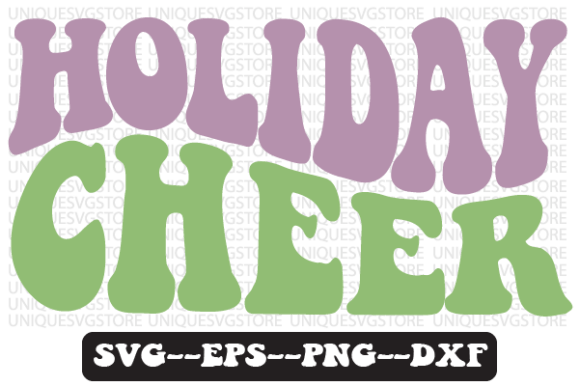
Holiday Cheer Wavy Retro SVG Design
First Impressions: A Nostalgic Wave with Real-World Charm
When I opened the Holiday Cheer Wavy Retro SVG Design, my first thought wasn’t “cute” or “festive”—it was “usable.” That wavy baseline isn’t just decorative; it’s a built-in rhythm that guides the eye and softens the holiday theme without leaning into cliché. The retro styling—slightly rounded letterforms, subtle weight shifts, and balanced negative space—feels intentional, not nostalgic for nostalgia’s sake. As an embroidery designer who’s stitched hundreds of holiday motifs, I appreciate how this design avoids visual clutter while still carrying warmth and personality. It reads clearly at 3–4 inches wide, which makes it ideal for a custom embroidered tote bag, a boutique sweatshirt, or a nursery pillow cover—products where legibility and charm matter more than complexity.
Where This Design Truly Shines in Real Embroidery Projects
I tested the Holiday Cheer Wavy Retro SVG Design across several real-use scenarios: a medium-weight cotton tote, a brushed fleece hoodie, and a lightweight baby onesie. On the tote, the wave’s gentle arc mirrored the natural drape of the fabric—no distortion, no awkward stretching. On the hoodie, it held up beautifully with a light tear-away stabilizer and standard poly thread; the curves stayed smooth, and the letter spacing remained even after washing. Even on the onesie—where tiny details often blur—I found the design scaled down cleanly to 2.75 inches without losing its retro voice.
This isn’t just a holiday graphic—it’s a versatile machine embroidery design that works as a standalone statement or a subtle accent. I’ve used it as a custom apparel chest logo on long sleeve tees, as a playful embroidered patch sewn onto denim jackets, and even digitized it lightly for a tea towel line (paired with simple running stitch borders). For Etsy sellers and small shop products, it bridges seasonal demand and year-round appeal—especially when paired with neutral palettes or monochrome thread choices.
Where Caution Is Needed—Not Flaws, Just Practical Realities
The Holiday Cheer Wavy Retro SVG Design is clean, but it’s not universally forgiving. On highly textured fabrics like terry cloth or bouclé, the wave’s subtlety can get lost—so I recommend pairing it with satin stitch fills or slightly heavier thread weights there. On stretchy knits (think lightweight tanks or baby bodysuits), skip direct-hooping and use cutaway + topping to preserve curve integrity. And while it prints beautifully on mugs and wall art as a printable PNG or sublimation file, remember: embroidery requires different considerations. That elegant thin line under the word “Cheer”? In dense fill stitch, it could vanish unless digitized with appropriate underlay or reduced density. Always test the design on scrap fabric first, especially if you’re using it for commercial embroidery or client work.
It also doesn’t love tiny hoops. Below 3 inches, some of the retro character flattens—so avoid cramming it into a 2-inch cap front unless you’re willing to simplify the wave manually. And on dark fabric? Confirm your thread color contrast early. What reads as cheerful in a mockup may mute into background noise if your gold or cream thread lacks enough tonal lift.
Design Integrity Meets Customer Trust
What sets this apart from generic holiday graphics is how it supports brand consistency and handmade product credibility. When customers see this on a boutique apron or a personalized gift box, they don’t think “clip art”—they sense craft intention. That matters for creative entrepreneurs building trust through detail. I’ve watched buyers pause longer on listings featuring this design because it feels curated, not templated. Its balance of retro familiarity and modern simplicity helps craft business owners stand out in crowded markets like Etsy or local fairs—without requiring advanced digitizing skills.
That said, its strength lies in restraint. It won’t carry a full collection alone—but as part of a cohesive set (say, paired with minimalist snowflakes or geometric trees), it becomes a memorable anchor. For digital embroidery file sellers, bundling it with coordinating applique designs or alternate colorways adds clear value.
Practical Notes Every Embroidery Designer Should Keep Handy
- Always check stitch density before stitching—especially in curved sections where overlapping fills can cause puckering.
- Confirm hoop size compatibility. If your machine defaults to small hoops, resize thoughtfully—not just proportionally.
- Inspect small details in black-and-white mockups. What looks warm on screen may lack contrast on navy fleece or charcoal sweatshirts.
- Use proper stabilizer: light cutaway for stable fabrics, cutaway + topping for knits or towels.
- Review licensing before selling finished items or reselling the digital file—this is a Graphics-category asset, so commercial use terms must be verified directly with the seller.
- Test thread colors across fabric types. A soft sage green reads festive on cream linen but disappears on olive cotton duck.
- Compare light and dark backgrounds in your design software—not just your embroidery editor—to anticipate customer expectations.
A Design That Earns Its Place—Not Just Its Season
The Holiday Cheer Wavy Retro SVG Design doesn’t shout. It leans in. That’s why it works so well for thoughtful projects: a hand-stitched kitchen towel for a wedding gift, a limited-run batch of embroidered patches for a local café’s holiday menu, or a personalized sweatshirt for a child’s first holiday photo session. It’s not flashy—but it’s reliable, expressive, and quietly professional. As a working designer and crafts reviewer, I don’t reach for this when I need drama. I reach for it when I need authenticity, clarity, and a little joyful rhythm—exactly what handmade products deserve.