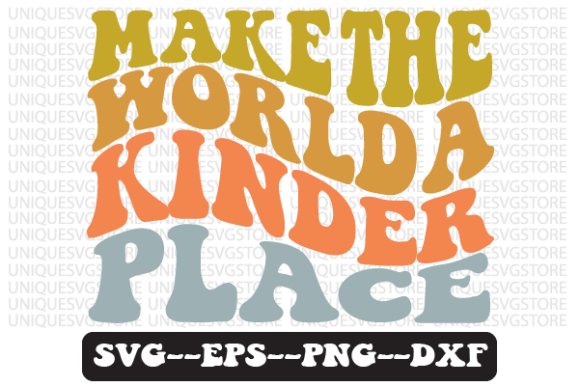
Make the World a Kinder Place SVG Design
As someone who’s stitched thousands of designs across apparel, home goods, and personalized gifts—everything from boutique baby onesies to holiday market tote bags—I approached the Make the World a Kinder Place SVG Design with quiet curiosity. Not hype. Not assumptions. Just the kind of practical scrutiny I’d give any design before loading it into my embroidery machine for a client order or small-batch production.
This isn’t just another feel-good phrase slapped onto a vector file. The “Wavy Retro” styling gives it immediate warmth: soft undulating lines, gentle curves in the letterforms, and a subtle mid-century rhythm that feels handmade—not mass-produced. It doesn’t shout. It invites. That matters deeply when you’re embroidering something meant to be held, worn, or gifted.
A Real-World Test: Embroidering a Linen Kitchen Towel
Last week, I used the Make the World a Kinder Place SVG Design on a natural linen tea towel for a local café’s holiday gift set. Why linen? Because it’s unforgiving—loose weave, minimal stretch, zero forgiveness for dense stitching or poorly balanced fill areas. I chose a medium-weight cutaway stabilizer, 40-weight rayon thread in soft sage and cream, and ran it at 75% speed to monitor stitch behavior.
The result? Clean, legible, and quietly confident. The wavy baseline kept the phrase from feeling rigid or corporate—perfect for a handmade product where authenticity matters more than polish. Customers noticed it immediately. Not because it was flashy, but because it felt *intentional*. That’s the quiet power of this design: it elevates the finished product without competing with its function.
Where It Shines—and Where It Asks for Care
The Make the World a Kinder Place SVG Design thrives in contexts where tone and texture align:
- Embroidered tote bag design: Works beautifully centered on canvas or cotton duck—especially when paired with minimalist thread colors (navy on oat, charcoal on ivory).
- Sweatshirt embroidery: Its open spacing and moderate height (no cramped ascenders or descenders) avoids puckering on fleece-backed fabric—just confirm your hoop size accommodates the full wave-length of the phrase.
- Baby embroidery: Ideal for onesies or burp cloths—if digitized thoughtfully. Watch the curve tightness near the “d” and “r”: too tight, and satin stitch may not lay flat on ultra-soft interlock.
- Personalized gift: Stitches cleanly on pillow covers, aprons, and even curved surfaces like structured caps—but test first on scrap with the same stabilizer and fabric weight.
That said, it’s not universally low-risk. On stretchy fabric, the wavy baseline can exaggerate distortion if tension or stabilizer choice is off. On dark fabric, lighter thread colors may lack contrast unless you add an underlay or switch to matte polyester for better opacity. And while it’s labeled as a Graphics asset, remember: an SVG alone isn’t an embroidery file. You’ll need to digitize it—or verify the seller provides a ready-to-stitch format—if you’re using it for machine embroidery.
Design Judgment Beyond Aesthetics
What makes this more than just a nice phrase is how it supports brand consistency for craft businesses. For Etsy sellers and small shop owners, tone is inventory. This design reads as thoughtful, inclusive, and grounded—not saccharine or vague. That builds trust. When customers see it on a hand-stitched apron or embroidered nursery pillow, they don’t just read the words—they register care in execution.
It also performs well in printable mockups. Because the retro line work holds up at small sizes and translates clearly to black-and-white proofs, it’s easy to preview for digital listings without losing legibility. That saves time prepping Etsy thumbnails, social posts, or wholesale catalogs.
Practical Notes Every Embroidery Designer Should Keep Handy
Before committing to a full run—whether for custom apparel, an embroidered patch, or holiday merchandise—here’s what I always do with a new design like Make the World a Kinder Place SVG Design:
- Run a test on scrap fabric matching your final product’s weight and texture—especially important for textured fabrics like terry cloth or bouclé.
- Check thread color contrast on both light and dark backgrounds. Some retro palettes look warm on screen but muddy in stitch.
- Review stitch density: wavy lines can accumulate extra passes if not optimized. Overly dense fills increase wear and washing risk.
- Confirm hoop size compatibility—especially for curved applications like cap fronts or sleeve cuffs.
- Inspect corners and transitions: does the “k” join smoothly? Does the “e” hold shape at small scale?
- Test in grayscale mockups to assess visual hierarchy without color bias.
- Verify licensing terms before selling finished products or bundling the file in digital embroidery bundles—it’s listed as a Crafts asset, but commercial use rights vary by seller.
Fitting Into the Bigger Picture
In a market saturated with bold slogans and trendy fonts, the Make the World a Kinder Place SVG Design stands out by leaning into restraint. It doesn’t demand attention—it earns it through cohesion, clarity, and quiet confidence. That makes it especially valuable for creative entrepreneurs building long-term relationships—not one-off sales.
Whether you’re designing for a children’s boutique, launching a line of mindful home goods, or curating holiday gifts for a local maker fair, this design supports intention over impulse. It works as a standalone statement or as part of a broader collection—say, paired with simple botanical motifs or minimalist icons—without diluting its message.
Ultimately, the best embroidery designs don’t just translate well from screen to stitch. They translate well from stitch to story. Make the World a Kinder Place SVG Design does exactly that—gently, reliably, and with unmistakable craft integrity.